
Refineries and petrochemical facilities around Baton Rouge operate within one of the Gulf Coast’s most concentrated industrial corridors. High-pressure process piping in these facilities must navigate equipment, structural steel, existing pipe racks, and complex plant layouts while maintaining the mechanical integrity required for demanding service.
Induction pipe bending provides a controlled way to create large-radius bends from straight pipe while limiting the need for multiple welded fittings. For Gulf Coast refinery and petrochemical projects, properly engineered induction bends can support efficient routing, reduce the number of circumferential welds associated with multi-fitting direction changes, and help piping designers meet project-specific pressure, temperature, material, and geometry requirements.
What local refinery and plant teams should know
-
Induction bending uses localized heating combined with controlled mechanical force to form a pipe to a specified bend geometry.
-
A single engineered bend may replace a direction change that would otherwise require multiple fittings and field or shop welds.
-
Refinery projects along the Mississippi River corridor must evaluate bends as part of the complete piping system, including design pressure, temperature, material properties, wall thickness, flexibility, supports, and applicable code requirements.
-
Baton Rouge-area facilities also operate in a hot, wet climate, making appropriate material selection, coatings, inspection, and long-term corrosion management important throughout the piping system.
-
Bend quality depends on controlling geometry and material effects rather than simply achieving the required change in direction.
Why Does Induction Pipe Bending Matter for Gulf Coast Refineries?
Induction pipe bending matters for Gulf Coast refineries because it allows designers and fabricators to create controlled pipeline direction changes while addressing pressure integrity, routing limitations, fabrication requirements, and the number of welded joints in a piping system.
The Baton Rouge region sits within Louisiana’s extensive refining and chemical manufacturing corridor. Industrial operations extend along the Mississippi River through communities and industrial areas including Port Allen, Plaquemine, St. Gabriel, Geismar, Gonzales, and Ascension Parish.
That concentration creates piping challenges that are different from those encountered on an open, undeveloped site. Brownfield modifications may need to fit new piping around operating equipment, existing structures, access routes, pipe racks, and maintenance clearances.
Metal Works Corporation serves this industrial environment from Baton Rouge, Louisiana. When we evaluate an induction bending application, the bend geometry is only part of the picture. Material specification, diameter, wall thickness, bend radius, end requirements, and the project’s applicable engineering specifications all affect the finished component.
How Does the Induction Bending Process Work?
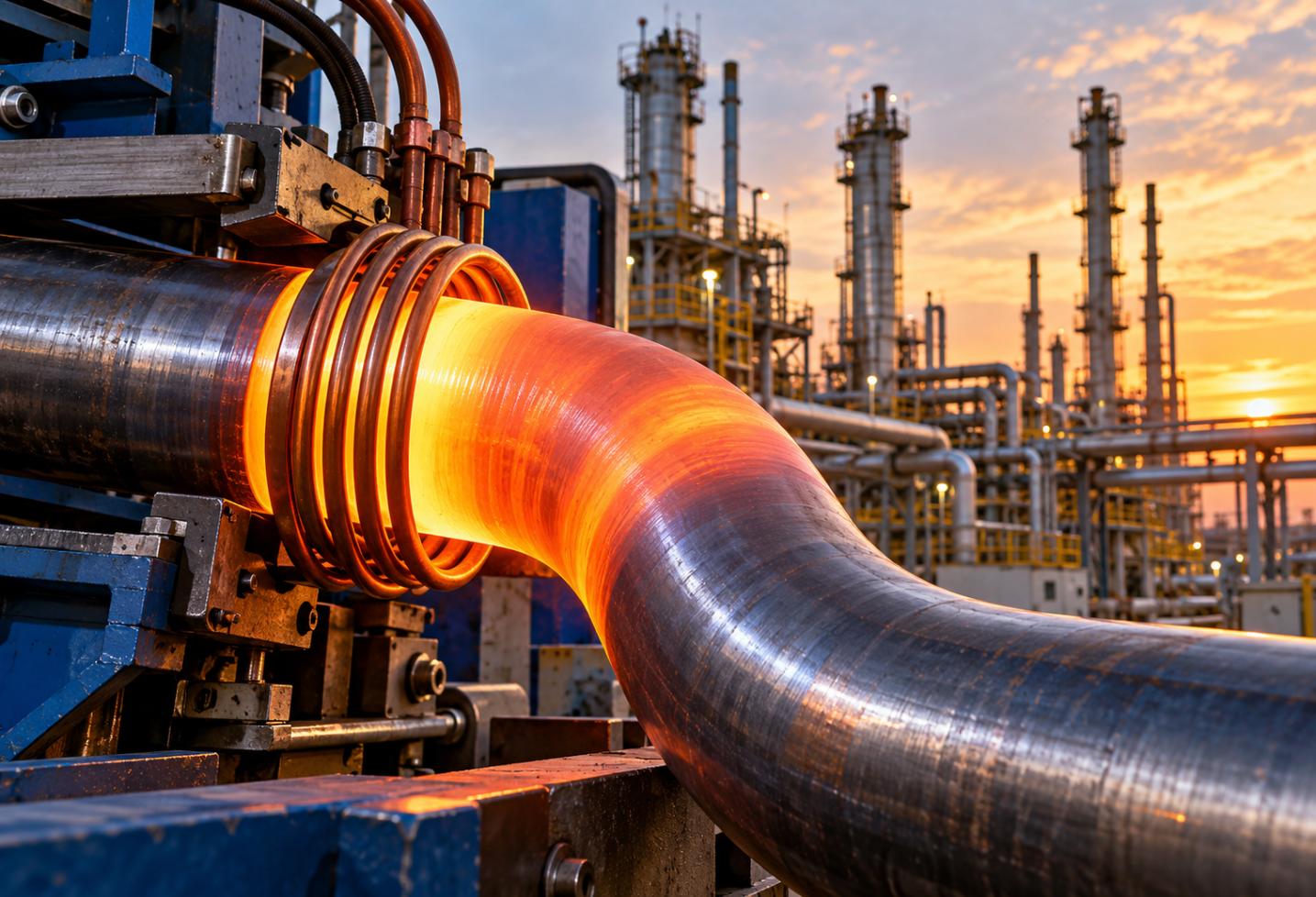
Induction bending works by heating a narrow section of pipe and moving that heated zone through a controlled bending operation, allowing the pipe to form progressively rather than heating the entire component at once.
An induction coil creates a concentrated heated zone around the pipe. As the pipe advances through the equipment, the bending system applies the force required to establish the specified radius. The heated section forms, then moves beyond the active heating zone as the process continues.
This localized approach gives the fabricator control over variables that influence the final bend. Depending on the material and project requirements, those variables can include heating conditions, feed rate, bending radius, cooling method, and dimensional tolerances.
For refinery work around Baton Rouge and the lower Mississippi River industrial corridor, those controls are particularly relevant when a piping design combines demanding operating conditions with limited routing space.
What Does Industry Guidance Say About Process Piping Bends?
Process piping bends must be evaluated within the engineering, fabrication, examination, inspection, and testing requirements that apply to the complete piping system rather than treated as isolated pieces of curved pipe.
ASME identifies B31.3 Process Piping as covering areas including design, materials, fabrication, assembly, erection, examination, inspection, and testing. Its technical scope includes bends and forming as well as pressure design, flexibility, supports, and high-pressure piping.
The applicable code and project specification depend on the particular system and service. Plant owners and engineers should establish those requirements before fabrication.
Local conditions also matter for long-term asset management. National Weather Service 1991-2020 climate normals report approximately 61.94 inches of annual precipitation at Baton Rouge Ryan Field. That wet Gulf Coast environment reinforces the importance of coating systems, drainage, insulation practices, inspection, and corrosion management after piping enters service.
How Can Precision Bends Support Pipeline Integrity?
Precision bends can support pipeline integrity by providing predictable geometry and reducing the number of separate components needed to create certain routing changes, provided the bend is properly engineered, fabricated, examined, and incorporated into the piping system.
Every additional fitting and weld introduces another fabrication and inspection location. Using a continuous induction bend may allow a designer to achieve a required change in direction without assembling several individual elbows and intermediate pipe sections.
That does not mean fewer welds automatically make a piping system safe. Integrity still depends on engineering design, material condition, fabrication quality, examination, supports, operating conditions, corrosion control, and maintenance.
The advantage is that induction bending gives engineers another routing option. In dense Baton Rouge-area refinery and chemical facilities, that flexibility can be valuable when new piping must integrate with existing infrastructure.
What Warning Signs Should Teams Watch for in a Pipe Bend?
Warning signs around a pipe bend include dimensional deviations, unexpected wall-thickness changes, surface imperfections, material concerns, or evidence that the finished geometry does not conform to the project specification.
Plant and project teams should pay particular attention to:
-
Bend radius or angle outside specified tolerances
-
Excessive ovality or cross-sectional distortion
-
Wall thickness that does not satisfy design requirements
-
Surface cracking or other visible imperfections
-
Unexpected wrinkling or deformation
-
Material or heat-treatment documentation that does not match project requirements
-
End dimensions that create fit-up problems during installation
-
In-service coating damage, corrosion, or deterioration around the bend
Acceptance criteria should come from the applicable code, engineering design, owner requirements, and project specification rather than a generic visual rule.
When Should an Induction Bend Be Professionally Evaluated?
An induction bend should be professionally evaluated whenever its geometry, material condition, pressure service, fabrication history, or inspection results could affect compliance with the piping design or project specification.
Basic visual monitoring can identify coating damage, obvious corrosion, or deformation in accessible installed piping. Determining whether a high-pressure process bend remains acceptable is different. That assessment may require engineering review, dimensional measurements, nondestructive examination, material verification, thickness measurements, or other procedures specified by the owner.
For facilities from Baton Rouge through Geismar and the broader Mississippi River corridor, planned turnaround work can provide an opportunity to address piping components that are difficult to access during normal operation.
What Common Factors Affect Induction Bend Quality?
Induction bend quality is most commonly affected by material characteristics, pipe dimensions, bend radius, thermal controls, forming parameters, and the dimensional requirements established for the finished component.
Material characteristics: Different pipe materials respond differently to heating and forming, so the bending procedure must reflect the specified material and service.
Wall thickness: Bending changes the geometry of the pipe. The finished component must maintain dimensions appropriate for its design requirements.
Bend radius: Tighter geometry generally creates different forming demands than a larger-radius bend.
Process control: Heating and forming must be controlled consistently to produce the intended geometry.
Project requirements: Refinery and chemical projects may specify examinations, heat treatment, dimensional checks, documentation, or testing based on the material and service.
These considerations are relevant throughout Louisiana’s industrial corridor, where piping may serve refinery, petrochemical, chemical manufacturing, and related process applications.
How Can Facilities Protect Induction Bends Over Their Service Life?
Facilities can protect induction bends by combining correct initial fabrication with appropriate coatings, supports, inspection, corrosion management, and maintenance based on the actual process service and exposure conditions.
In the Baton Rouge climate, exterior piping can experience frequent moisture exposure. Insulated systems can present additional inspection considerations when water reaches areas concealed beneath insulation.
Useful maintenance practices include checking coating condition, monitoring known corrosion locations, maintaining appropriate insulation and weather barriers, verifying supports, and following the facility’s inspection program.
DIY-style repairs have little place on pressure-retaining refinery piping. Plant personnel may identify and document visible concerns, but engineering assessment and pressure-boundary work should follow established facility procedures.
What Results Should Refinery Teams Expect From a Properly Specified Bend?
A properly specified induction bend should provide the required direction change while meeting the dimensional, material, fabrication, examination, and documentation requirements established for the piping project.
Depending on the layout, induction bending may also simplify routing and reduce the number of individual fittings and welds required for a particular configuration. The actual benefit depends on pipe size, material, radius, schedule, service conditions, site geometry, fabrication requirements, and installation plan.
For brownfield projects near the Mississippi River, accurate dimensional planning is especially important because existing infrastructure can leave little room for field adjustments.
What Mistakes Can Undermine a High-Pressure Bending Project?
The most damaging mistakes occur when teams treat bending as a geometry-only task instead of considering material behavior, pressure design, inspection, installation, and the complete piping specification.
Mistake: Selecting a bend only by angle.
Consequence: The resulting radius, tangent dimensions, or wall condition may not suit the piping design.
Better approach: Define material, size, wall, radius, angle, tangent requirements, and applicable specifications before fabrication.
Mistake: Ignoring installation geometry.
Consequence: A correctly fabricated bend may still create fit-up problems in a congested unit.
Better approach: Coordinate fabrication dimensions with field measurements and piping design.
Mistake: Assuming every material responds identically.
Consequence: Thermal and mechanical effects can vary by material.
Better approach: Use bending procedures appropriate to the specified material and project requirements.
Mistake: Treating documentation as an afterthought.
Consequence: Turnover and verification can become more difficult.
Better approach: Establish required material records, dimensional reports, examinations, and other documentation before production.
What Is a Common Baton Rouge Refinery Scenario?
A common Baton Rouge-area scenario involves rerouting or replacing process piping within an existing industrial unit where equipment, structures, and adjacent lines restrict the available path.
The engineering team may need to move a line around an obstruction while controlling the number and location of connections. Instead of automatically creating the routing from several standard elbows and short pipe sections, the team can evaluate whether an induction bend provides suitable geometry.
This is a general local scenario, not a Metal Works Corporation project example. The final solution would depend on the owner’s design, code requirements, piping specification, field dimensions, and service conditions.
What Services Support a Successful Induction Bending Project?
Successful induction bending projects require coordination between engineering requirements, material specifications, bend geometry, controlled fabrication, inspection requirements, and installation planning.
Our role begins with understanding what the project requires rather than assuming one bend configuration fits every application. Clear information about material, outside diameter, wall thickness, radius, angle, tangents, quantity, service, and applicable specifications helps establish whether an induction bending solution is appropriate.
How Does Induction Bending Compare With Fabricated Fitting Assemblies?
Induction bending and fabricated fitting assemblies can both provide pipeline direction changes, but they differ in component count, weld count, geometry, fabrication planning, and suitability for a particular plant layout.
A series of standard elbows can be practical when standard geometry matches the route and installation requirements. An induction bend can be advantageous when a project calls for a continuous radius, specific routing geometry, or fewer individual components.
Neither method is universally preferable. The engineering team should compare design requirements, available space, material, constructability, examination requirements, schedule, and total installed configuration.
Where Are Induction Bending Applications Relevant Around Baton Rouge?
Induction bending applications are relevant throughout Baton Rouge and the industrial communities along Louisiana’s Mississippi River corridor, where refinery, petrochemical, chemical, and heavy industrial facilities depend on extensive process piping systems.
That includes industrial operations in East Baton Rouge Parish as well as areas around Port Allen, Plaquemine, St. Gabriel, Geismar, Gonzales, and Ascension Parish. Project requirements vary by facility, owner, process, and piping service.
What Can It Cost to Ignore Bend and Piping Integrity Concerns?
Ignoring a questionable bend or other pressure-piping concern can allow a manageable inspection or maintenance issue to become a larger reliability, repair, or operational problem.
The actual consequences depend on the service and condition involved. Potential impacts can include additional inspection work, unplanned repairs, replacement scope, schedule disruption, or process downtime. For continuously operating Gulf Coast facilities, early evaluation allows maintenance and engineering teams to make decisions with better information.
Frequently Asked Questions About Induction Pipe Bending
What is induction pipe bending?
Induction pipe bending is a controlled forming process that uses localized induction heating while mechanical force forms pipe to a specified radius. Because only a relatively narrow area is actively heated during forming, the process can produce continuous bends for industrial piping applications without assembling the entire direction change from multiple fittings.
Why is induction bending useful for Baton Rouge refineries?
Induction bending can be useful in Baton Rouge refineries because existing units often contain dense combinations of process equipment, structural steel, pipe racks, and operating lines. A purpose-designed bend can provide engineers with additional routing flexibility while potentially reducing the number of separate fittings and circumferential welds needed for certain configurations.
Can induction bends be used in high-pressure piping?
Induction bends can be used in high-pressure applications when the finished component satisfies the applicable engineering design, code, material, dimensional, fabrication, examination, and testing requirements. High pressure should never be treated as a generic application category. The responsible engineering team must evaluate the specific piping system and service.
Does an induction bend eliminate welding?
No. An induction bend can reduce the number of fittings and associated welds required for some routing configurations, but it does not necessarily eliminate welding from the piping system. Connections to adjacent pipe, equipment, valves, or other components still depend on the piping design and installation method.
Does Baton Rouge weather affect industrial piping integrity?
Yes. Baton Rouge has a warm, wet climate, with National Weather Service climate normals showing about 61.94 inches of annual precipitation at Ryan Field. Environmental exposure is therefore one factor in long-term corrosion management, coating maintenance, insulation inspection, and other mechanical-integrity activities for outdoor industrial piping.
Is induction bending useful for brownfield refinery modifications in Louisiana?
Yes, it can be. Brownfield projects in Louisiana often require new or replacement piping to fit around existing plant infrastructure. Induction bending gives piping designers another way to develop routing geometry, although field dimensions, constructability, supports, code requirements, and owner specifications still determine whether it is suitable.
What information is needed before ordering an induction bend?
The required information typically includes the pipe material, outside diameter, wall thickness or schedule, bend radius, bend angle, tangent requirements, quantity, and applicable project specifications. Additional fabrication, heat-treatment, examination, testing, or documentation requirements may apply depending on the material, service, owner, and governing design requirements.
Are induction bends only relevant to Baton Rouge facilities?
No. The process is relevant throughout the Gulf Coast industrial region. For local projects, that includes facilities along the Mississippi River corridor near Port Allen, Plaquemine, St. Gabriel, Geismar, Gonzales, and other South Louisiana industrial communities where process piping is central to refinery, petrochemical, and chemical operations.
Build High-Pressure Piping Around the Requirements of the Application
For Gulf Coast process facilities, a pipe bend is part of an engineered pressure system, not simply a way to turn a line. Careful control of material, geometry, fabrication, examination, and installation requirements helps plant teams integrate bends into demanding refinery and petrochemical piping applications.
Plan Your Next Gulf Coast Induction Bending Project With Confidence
Metal Works Corporation can work from defined project requirements to help industrial teams evaluate induction bending needs for Baton Rouge and the surrounding Gulf Coast industrial corridor.