
In Baton Rouge, process piping often operates in an industrial environment where reliability matters as much as initial fabrication cost. Chemical plants, bulk-handling operations, terminals, and other facilities along the Mississippi River corridor may move abrasive slurries, corrosive chemicals, or high-velocity process streams that punish poorly designed changes in direction.
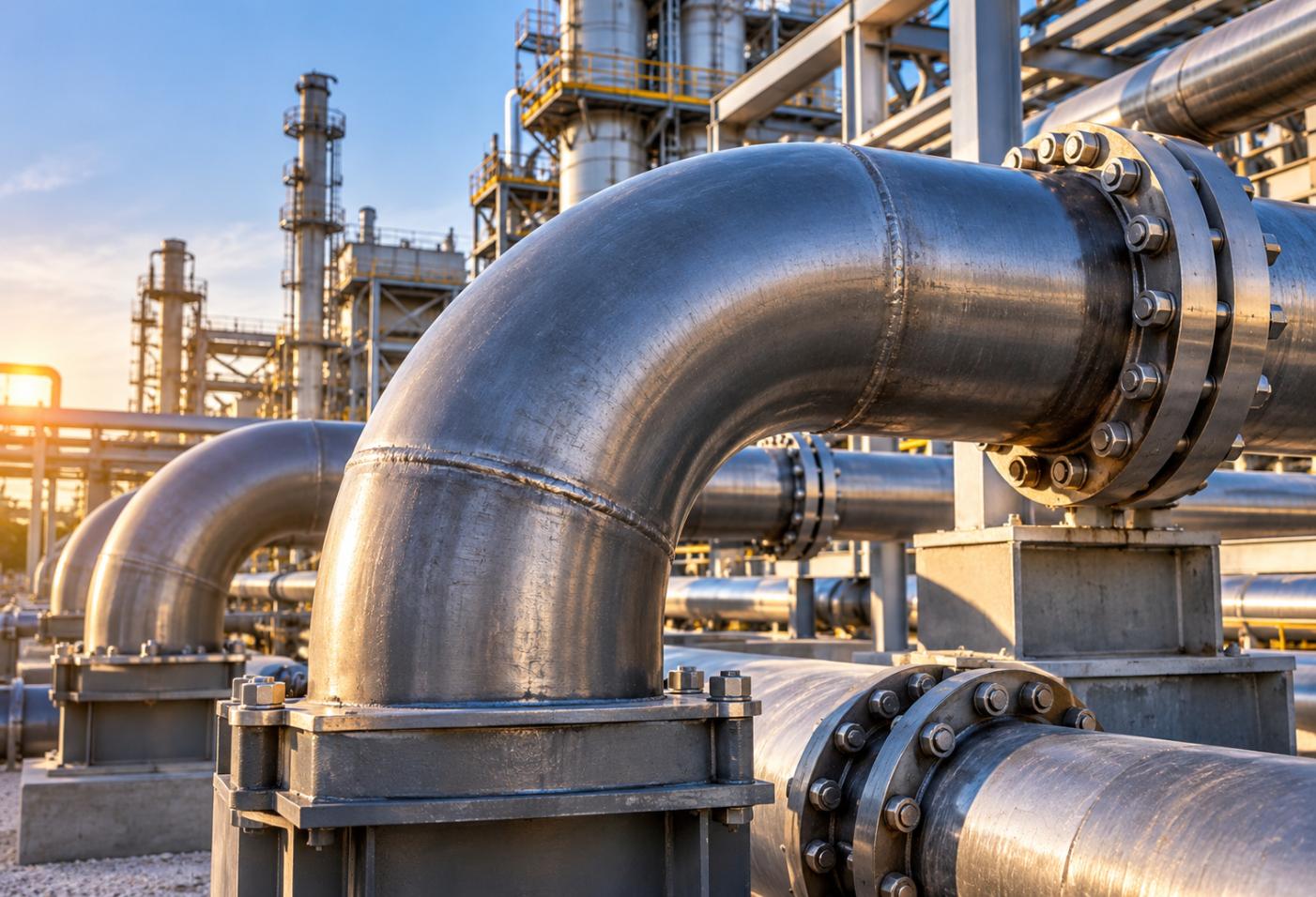
For certain demanding applications, a custom heavy-wall pipe bend can provide a smoother flow path than a tight fabricated elbow. That smoother directional change may reduce turbulence, localized erosion, vibration, and stress concentration, helping engineers address recurring wear points before they become maintenance problems.
Quick answer: Heavy-wall pipe bending creates a continuous curved section from pipe, while fabricated elbows create directional changes through fittings or joined segments. In high-velocity slurry and chemical service, a properly engineered long-radius custom bend can reduce abrupt flow changes and localized wear. The right solution still depends on velocity, solids content, chemistry, temperature, pressure, available space, material, wall thickness, and applicable piping requirements.
What Baton Rouge plant teams should know
-
Abrasive solids can make directional changes some of the fastest-wearing locations in slurry piping.
-
Longer, smoother curves can reduce abrupt changes in fluid momentum compared with tighter directional fittings.
-
Facilities throughout East Baton Rouge, West Baton Rouge, Ascension, and Iberville parishes operate within a heavily industrialized Mississippi River corridor.
-
Chemical compatibility, pressure, temperature, pipe material, wall thickness, and bend geometry all need consideration before specifying a custom curve.
-
A bend that occupies more space may offer maintenance advantages in severe service, but tighter elbows can remain appropriate where layout constraints or process requirements dictate.
Why Do Heavy-Wall Pipe Bends Matter in Baton Rouge Process Piping?
Heavy-wall pipe bends matter in Baton Rouge because the region supports extensive petrochemical, chemical, bulk-material, and process manufacturing operations where piping reliability can directly affect maintenance and production. Louisiana Department of Environmental Quality describes the Capital Region as being in the heart of the Mississippi River industrial corridor and as one of Louisiana’s most active manufacturing and petrochemical regions.
The Port of Greater Baton Rouge also handles liquid and dry bulk materials and serves industries along the Mississippi River. Its jurisdiction includes Ascension, East Baton Rouge, Iberville, Pointe Coupee, and West Baton Rouge parishes, making heavy industrial piping a particularly relevant subject for the local market.
Metal Works Corporation serves this industrial market from Baton Rouge, LA. When we evaluate custom bending as part of a piping solution, the central question is not simply whether a pipe can be curved. The geometry has to make sense for the process conditions and the system in which that bend will operate.
How Does a Custom Curve Reduce Erosion?
A custom curve can reduce erosion by spreading a fluid’s directional change over a longer path instead of forcing the stream through an abrupt turn. This can be especially valuable when suspended solids repeatedly strike the outside wall of a bend or when high velocity produces severe turbulence around a directional change.
Think about slurry moving through a pipe. The liquid follows the piping geometry, but solid particles carry momentum. At a sharp turn, those particles can concentrate impact on particular portions of the wall.
A larger-radius bend changes that trajectory more gradually. It does not eliminate abrasive wear, but it can change where and how aggressively particles interact with the pipe wall.
For plants from north Baton Rouge through the Mississippi River industrial corridor toward Geismar, that distinction can matter in lines carrying abrasive or erosive process media.
How Can Pipe Geometry Affect Fatigue?
Pipe geometry can affect fatigue because abrupt directional changes can contribute to turbulence, vibration, cyclic loading, and concentrated stresses within a piping system. A properly engineered custom bend provides a continuous change in direction that may help create smoother flow conditions than a more abrupt configuration.
Fatigue is rarely explained by bend geometry alone. Supports, pressure cycling, temperature changes, equipment vibration, material properties, weld details, and operating conditions can all contribute.
That is why repeated problems near the same elbow deserve investigation rather than automatic like-for-like replacement. If a chemical or slurry line around Baton Rouge repeatedly experiences vibration, wall loss, cracking, or weld problems at directional changes, the piping geometry should be part of the review.
What Warning Signs Suggest a Directional Fitting Is Becoming a Problem?
Warning signs of a troublesome directional fitting include localized wall loss, recurring leaks, vibration, damaged supports, repeated weld repairs, unusual noise, and maintenance concentrated around the same change in direction. These symptoms do not prove that an elbow is the cause, but they justify closer inspection.
Watch for:
-
Repeated thinning on the outside radius of an elbow or bend
-
Frequent repairs at or near the same fitting
-
Visible vibration during normal operation
-
Cracking or recurring weld defects around directional changes
-
Unexpected wear in downstream components
-
Pipe support movement or loosening
-
Process instability associated with high flow rates
-
Shorter-than-expected service life at specific turns
In Baton Rouge process facilities, inspection findings should be considered alongside the actual process medium and operating history.
When Should a Plant Consider a Custom Heavy-Wall Bend?
A plant should consider a custom heavy-wall bend when directional changes experience severe erosion, high velocity, repeated maintenance, demanding pressure or temperature conditions, or when a larger bend radius could improve the piping geometry. Engineering review should determine whether the bend is appropriate for the specific system.
A visual inspection alone cannot establish the correct radius, wall thickness, material, or fabrication approach. Those decisions require design inputs.
Useful information includes pipe size, material grade, nominal wall thickness, required bend angle and radius, process medium, design pressure and temperature, corrosion or erosion allowance, and applicable specifications.
For facilities in East Baton Rouge Parish and neighboring industrial areas, planned outages can be an especially useful time to review chronic elbow problems before simply ordering another identical replacement.
What Common Conditions Accelerate Wear in Slurry and Chemical Lines?
The most common conditions that accelerate directional wear are abrasive solids, excessive velocity, corrosive chemistry, turbulent flow, cyclic operation, and combinations of erosion and corrosion. Baton Rouge’s concentration of chemical processing and bulk-material infrastructure makes these mechanisms relevant across multiple industrial applications.
Abrasive slurry can mechanically remove material. Corrosive chemicals can attack the pipe surface. When both mechanisms occur together, the resulting damage pattern may be more complicated than either mechanism by itself.
Operating changes matter too. Increasing throughput through an existing line can change velocity and wear behavior even though the piping layout has not changed.
That is why a chronic elbow problem should be reviewed as a system problem, not just a worn component.
How Can Plants Reduce Premature Bend and Elbow Wear?
Plants can reduce premature bend and elbow wear by monitoring wall thickness, controlling process conditions where practical, reviewing high-wear locations, maintaining supports, and selecting geometry and materials for the actual service. Preventive inspection is particularly valuable before planned turnarounds or production changes.
Maintenance teams can track whether wall loss repeatedly develops in the same location. Engineering teams can compare those findings against flow rate, solids loading, chemistry, and operating cycles.
The Baton Rouge climate also makes exterior protection worth attention. National Weather Service 1991-2020 climate normals show about 61.94 inches of annual precipitation at Baton Rouge Ryan Field, so exposed industrial piping and supports face a wet regional environment in addition to internal process conditions.
Internal erosion and external corrosion are different mechanisms, but both belong in a complete piping inspection program.
What Results Can a Properly Selected Custom Bend Provide?
A properly selected custom bend can provide a smoother directional transition, appropriate heavy-wall construction, and geometry tailored to the available piping layout and process requirements. In suitable applications, those characteristics may help reduce localized wear and recurring maintenance compared with simply repeating a problematic tight-turn configuration.
Results depend on the service. No bend geometry can make an abrasive or corrosive process maintenance-free.
The objective is to match the component to the operating environment so maintenance teams are not repeatedly addressing a predictable weak point.
What Mistakes Should Baton Rouge Facilities Avoid?
Baton Rouge facilities should avoid treating every worn elbow as an isolated replacement problem because repeated failure often signals a broader issue involving flow, material, geometry, supports, or operating conditions.
Mistake: Replacing the same worn elbow without investigating the wear pattern.
Consequence: The new component may develop damage in the same location.
Better approach: Review velocity, solids, chemistry, wall-loss location, and geometry.
Mistake: Choosing bend radius only by available space.
Consequence: A compact layout may preserve an unfavorable flow condition.
Better approach: Balance footprint with process and maintenance requirements.
Mistake: Assuming thicker pipe automatically solves erosion.
Consequence: Added wall thickness may extend service life without addressing the mechanism causing concentrated wear.
Better approach: Evaluate thickness, material, geometry, and process conditions together.
Mistake: Waiting for a leak before investigating recurring wear.
Consequence: Repairs can become reactive and harder to coordinate with Baton Rouge-area outage schedules.
Better approach: Use inspection history to identify developing problem locations.
What Is a Common Local Slurry-Line Scenario?
A common Baton Rouge-area scenario is a process line that repeatedly shows its greatest wall loss around a directional change while adjacent straight pipe retains more thickness. This is a representative scenario, not a Metal Works Corporation case study.
Suppose inspection data shows recurring wear concentrated around the outside of an elbow. Replacing the elbow may restore the line temporarily, but the wear pattern suggests that flow behavior deserves investigation.
Engineering may evaluate whether a larger-radius heavy-wall bend, different material, revised operating conditions, or another system change would better address the service.
That kind of analysis is particularly relevant across the industrial corridor extending from the Capital Region toward Ascension Parish and the River Region.
What Service Solutions Support High-Wear Piping?
Service solutions for high-wear piping can include custom pipe bending and fabrication matched to the dimensions, materials, and geometry required by the project. The exact fabrication solution should follow the plant’s engineering requirements and applicable specifications.
For a custom bend request, providing complete project information helps define what is needed. Pipe diameter, wall thickness, material, centerline radius, bend angle, end configuration, quantity, and required documentation are useful starting points.
Heavy-Wall Pipe Bend or Fabricated Elbow: Which Fits the Application?
The right choice between a heavy-wall pipe bend and a fabricated elbow depends on flow conditions, required radius, available space, material, wall thickness, fabrication requirements, maintenance history, and system design. Neither option should be selected solely because it is familiar or convenient.
| Consideration | Custom Heavy-Wall Bend | Fabricated Elbow |
|---|---|---|
| Direction change | Continuous curved pipe | Fitting or fabricated directional section |
| Radius flexibility | Can be specified for project geometry | Depends on fitting or fabrication design |
| Space requirement | Larger radii may require more room | Compact configurations may use less room |
| High-wear service | Larger radius may help manage localized erosion | Requires evaluation for specific wear conditions |
| Layout customization | Useful for project-specific routing | Useful where standard or fabricated geometry fits |
| Selection basis | Engineering and service conditions | Engineering and service conditions |
For chemical plants and bulk-processing operations around Baton Rouge, the most useful comparison is the one based on actual operating conditions.
Where Is This Type of Industrial Piping Relevant Locally?
This type of industrial piping is relevant throughout Baton Rouge and the surrounding Mississippi River industrial corridor, including East Baton Rouge, West Baton Rouge, Ascension, and Iberville parishes. Port Allen, Geismar, and other nearby industrial communities are also part of the broader regional manufacturing and logistics network.
The Port of Greater Baton Rouge connects Mississippi River, Gulf Intracoastal Waterway, rail, highway, and terminal infrastructure, reinforcing the area’s role in petrochemical, bulk-material, and industrial operations.
What Can Happen If Recurring Elbow Wear Is Ignored?
Ignoring recurring elbow wear can allow progressive wall loss, vibration, leaks, unplanned maintenance, or piping damage to continue until intervention becomes more disruptive. The practical cost is not only the replacement fitting but also inspection, labor, production coordination, cleanup, and potentially unplanned downtime.
A recurring wear point in a Baton Rouge process line deserves evaluation while the facility still has options for planning the repair.
Frequently Asked Questions About Heavy-Wall Pipe Bending
Are custom pipe bends better than elbows for slurry lines in Baton Rouge?
Custom pipe bends can be advantageous for some Baton Rouge slurry lines because a larger radius creates a more gradual directional change that may reduce concentrated particle impact and turbulence. The best configuration depends on slurry composition, velocity, pipe size, wall thickness, material, pressure, temperature, and available space.
Why do slurry lines often wear faster at elbows?
Slurry lines often wear faster at elbows because suspended particles carry momentum into the directional change and can repeatedly strike portions of the pipe wall. The resulting erosion pattern depends on particle characteristics, velocity, concentration, geometry, material, and other process conditions.
Does heavier wall pipe prevent erosion?
Heavier wall pipe does not prevent erosion, although additional thickness may provide more material before minimum allowable thickness is reached. For Baton Rouge-area industrial lines with recurring wear, engineers should also consider velocity, bend radius, material, chemistry, solids, and the location of observed wall loss.
Can custom bends be used in chemical process lines?
Custom bends can be used in chemical process lines when their material, dimensions, fabrication, design, and documentation meet the requirements of the particular piping system. Chemical compatibility, pressure, temperature, corrosion allowance, applicable specifications, and inspection requirements should be established before fabrication.
What information is needed to request a custom pipe bend?
A custom pipe bend request generally starts with pipe size, material, wall thickness, bend angle, centerline radius, quantity, and project requirements. For an industrial project in Baton Rouge or the surrounding River Region, supplying drawings and applicable specifications can help communicate the required geometry and fabrication scope.
Should a Baton Rouge plant replace a repeatedly failing elbow with the same fitting?
A repeatedly failing elbow should be investigated before an identical replacement is automatically selected. If inspection records show recurring damage at the same Baton Rouge plant location, engineering should consider flow conditions, process chemistry, supports, vibration, material, geometry, and previous wall-thickness measurements.
How does Baton Rouge weather affect industrial piping?
Baton Rouge’s wet climate can contribute to exterior corrosion concerns for exposed piping, supports, coatings, and related steel components. National Weather Service climate normals report roughly 62 inches of annual precipitation at Baton Rouge Ryan Field. Internal erosion or chemical attack remains a separate process-side concern.
When should a plant evaluate pipe bending before a turnaround?
A plant should evaluate custom pipe bending early enough to confirm geometry, material availability, fabrication requirements, inspection needs, and installation constraints before the turnaround begins. Early planning is particularly useful when replacing a chronic wear point rather than performing a straightforward like-for-like component change.
Plan the Curve Around the Service, Not Just the Layout
High-velocity slurry and chemical piping can make every directional change a critical design and maintenance location. For Baton Rouge industrial facilities, examining radius, wall thickness, material, process conditions, and wear history together can reveal opportunities to improve a problem section rather than repeatedly replacing it.
Reduce Recurring Wear With a Bend Built for the Application
Metal Works Corporation can help start the conversation around custom pipe bending needs for industrial projects in the Baton Rouge area. Bring us your project requirements so the appropriate fabrication scope can be evaluated.