

When you’re responsible for keeping a chemical plant, refinery, or industrial processing facility operating, you know that piping problems rarely happen at a convenient time. A worn elbow, unexpected pressure drop, or leaking connection can interrupt production and create additional work for maintenance teams already managing demanding schedules. In slurry piping systems, these concerns become particularly important because the fluid carries solid particles that can gradually wear away pipe walls. For plant engineers and maintenance supervisors throughout Baton Rouge, LA, the way a piping system changes direction deserves careful consideration.
Custom pipe bending and welded elbows are two approaches to creating directional changes in industrial piping. A properly designed continuous bend may reduce the number of welded joints and provide a more gradual flow path, while a fabricated elbow assembly can accommodate specific dimensional or installation constraints. However, reducing turbulence and abrasive wear depends on more than simply choosing one method over the other. Bend radius, slurry velocity, particle characteristics, wall thickness, and material selection all influence performance.
Here’s what Gulf Coast industrial professionals should understand:
- Slurry flow creates specialized wear concerns: Solid particles can strike pipe walls as the mixture changes direction, particularly in systems operating at higher velocities.
- Custom bends may reduce welded connections: A continuous bend can sometimes replace an assembly that would otherwise require multiple pipe sections and welds.
- Bend radius affects flow behavior: A gradual change in direction may reduce certain flow disturbances, but it doesn’t automatically eliminate particle erosion.
- Material specifications remain essential: Wall thickness, alloy selection, inspection requirements, and applicable piping codes must be considered.
- Fabrication planning supports maintenance schedules: Baton Rouge refineries and chemical plants can benefit from coordinating specialized piping components before planned shutdowns.
At Metal Works Corporation, we’ve served industrial operations throughout Baton Rouge and the Gulf Coast since 1956. Our local facility brings together custom pipe and tube bending, pipe coiling services, precision machining, and ASME-certified welding capabilities. We work with petroleum refineries, chemical plants, and other industrial customers to produce application-specific components that meet their established material, dimensional, and fabrication requirements.
Why Are Pipe Bends and Elbows Important in Industrial Slurry Systems?
Pipe bends and elbows are important in industrial slurry systems because they redirect mixtures containing liquids and suspended solid particles. These directional changes influence local flow patterns, pressure losses, and particle impacts, making the geometry and construction of each fitting relevant to piping performance.
How Slurry Flow Differs From Ordinary Liquid Flow
A slurry contains solid material suspended or transported within a liquid. Depending on the process, those particles may vary considerably in size, shape, concentration, and abrasiveness.
When the mixture travels through a straight pipe, the particles move according to the prevailing flow conditions. As the pipeline changes direction, particle inertia and secondary flow patterns can cause solids to concentrate or strike particular areas of the bend.
Repeated impacts may gradually remove material from the internal pipe surface. The severity depends on the slurry properties and piping operating conditions.
Why Direction Changes Deserve Attention
Bends and elbows are natural areas of interest during slurry system inspections because particle trajectories change as the flow turns. Localized erosion can develop along particular sections of the fitting, although the exact wear location varies.
Research published in the Journal of Pipeline Systems Engineering and Practice has demonstrated that slurry erosion depends on factors including bend geometry, particle size, and flow velocity.
For chemical and industrial processing operations along the Mississippi River corridor, understanding those relationships can help teams evaluate piping replacement options more carefully.
What Happens When Wear Goes Unaddressed?
Progressive erosion can reduce wall thickness, potentially affecting the piping system’s ability to withstand operating conditions. Depending on the service, a serious loss of material may eventually create leakage or other mechanical integrity concerns.
In industrial facilities handling hazardous or high-pressure process materials, these conditions require particular attention.
Pipe condition should be assessed using the facility’s established inspection and mechanical integrity procedures rather than relying exclusively on visible external wear.
How Does Custom Pipe Bending Compare With Welded Elbows?
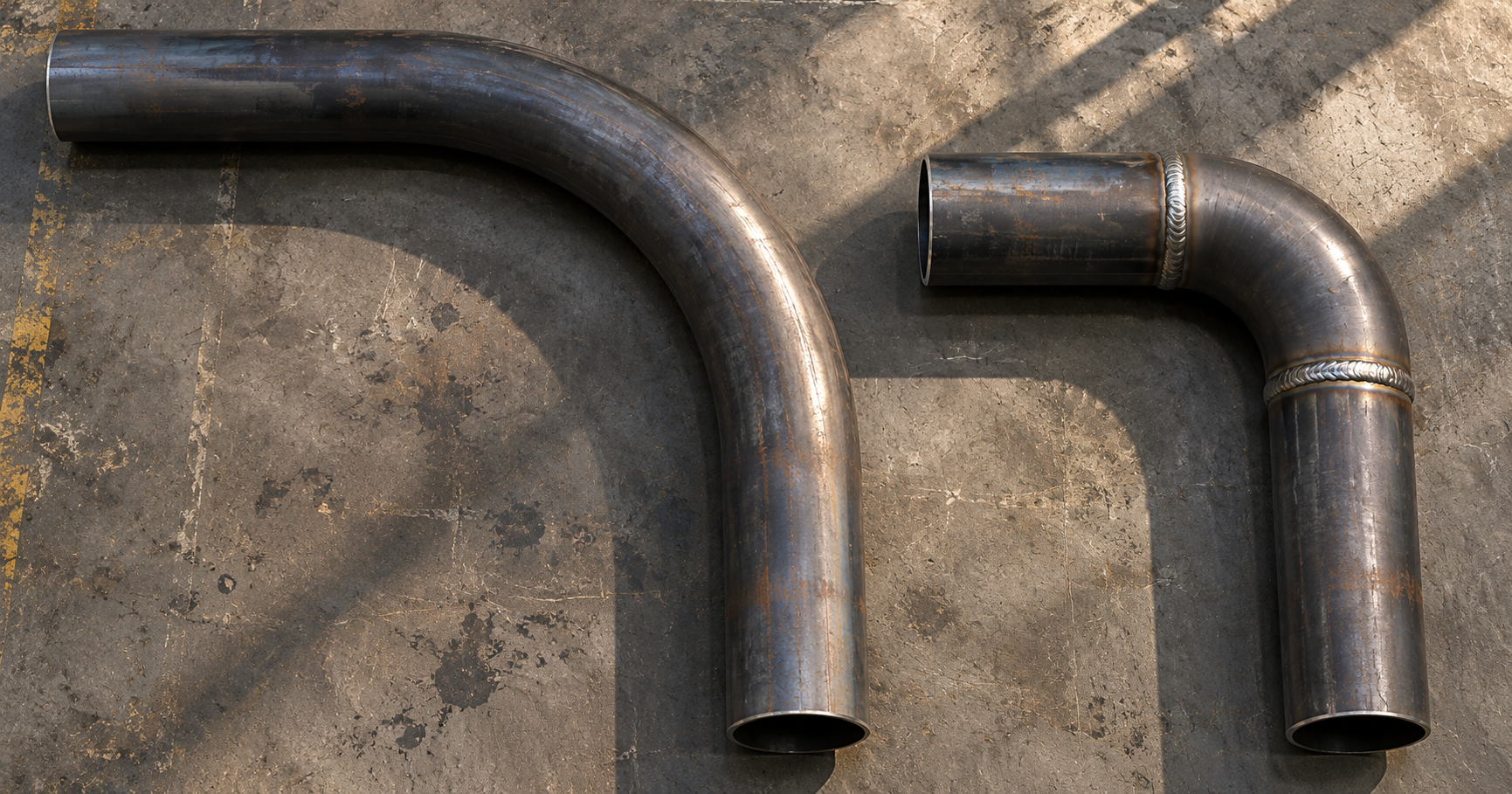
Custom pipe bending creates a directional change by forming a continuous length of pipe, while welded elbow assemblies use separately manufactured or fabricated components joined to adjacent piping. Both approaches can meet demanding industrial requirements, but they differ in joint count, dimensional flexibility, fabrication methods, and potential flow characteristics.
Understanding Custom Pipe Bending
Custom pipe bending reshapes pipe to a specified radius and angle while maintaining the required dimensional and material characteristics.
Depending on the process and application, bending may be performed using cold forming or other specialized methods. The finished component must satisfy applicable requirements for wall thickness, geometry, and material condition.
A continuous bend can reduce the number of connections needed to create a particular piping route. However, the bend may still require welds where it connects to the surrounding system.
Understanding Welded Elbow Assemblies
A welded elbow assembly uses one or more elbows and pipe sections joined through appropriately qualified welding procedures.
This approach can be useful when space restrictions, existing piping arrangements, or design requirements make a fabricated configuration appropriate.
A properly specified and welded elbow isn’t inherently inferior to a continuous bend. Both options can be suitable when engineered for the service conditions and fabricated according to applicable requirements.
Comparing the Two Approaches
| Consideration | Custom pipe bending | Welded elbow assembly |
|---|---|---|
| Construction | Direction change formed in a continuous pipe section | Direction change created using joined components |
| Weld count | May reduce intermediate welds | Can require additional circumferential welds |
| Geometry | Can be tailored to available bending capabilities | Depends on selected components and fabrication layout |
| Flow behavior | Influenced by bend radius and internal geometry | Influenced by elbow geometry and assembly details |
| Inspection | Requires verification of bend dimensions and material condition | Requires relevant component and weld inspections |
| Installation | Must fit the designed route and available clearances | Can offer flexibility for constrained or segmented layouts |
The correct choice depends on the project’s specifications rather than the assumption that one construction method always performs better.
Can Custom Pipe Bending Reduce Turbulence and Slurry Erosion?
Custom pipe bending can reduce certain flow disturbances when it provides a suitable bend radius and smoother internal transition compared with an alternative piping arrangement. However, a continuous bend doesn’t automatically reduce erosion, and an improperly selected geometry may still experience significant localized wear.
Why Bend Radius Matters
Bend radius describes the curvature of the piping as it changes direction.
A gradual directional change can behave differently from a tighter turn because the slurry particles encounter different flow patterns and forces.
In some applications, increasing the bend radius may reduce abrupt flow changes. However, research on particle erosion shows that the relationship between radius and wear is not universally linear.
A longer-radius bend can change where particles strike the pipe, and certain slurry conditions may create substantial wear even with a gradual curve.
Particle Size and Velocity Influence Wear
Larger or more abrasive particles can create different erosion patterns than smaller, less abrasive solids. Higher velocities may also increase the intensity of particle impacts, depending on the system.
For a Baton Rouge processing facility, two pipelines with the same diameter and bend radius may behave differently when they transport different slurries.
That’s why a custom bend should be evaluated using the actual process information rather than only its dimensions.
The Difference Between Turbulence and Erosion
Turbulence describes irregular fluid motion, while erosion involves material removal from the pipe wall.
These processes can be related, but they’re not identical. A change that reduces some flow disturbances doesn’t necessarily produce a proportional reduction in erosion.
A properly designed bend may offer advantages within a particular piping system, but claims about wear reduction should be supported by the relevant engineering assessment.
Why Fabrication Precision Matters
A custom bend must retain suitable wall thickness and dimensions after forming. Excessive thinning, ovality, or other dimensional problems may affect its suitability for service.
At our Baton Rouge shop, we provide custom pipe bending to specified radii and dimensions, including thin-wall, heavy-wall, and multi-plane configurations.
Our capabilities include cold bending pipe from 1/8 inch to 16 inches outside diameter, with available close-radius and compound bending options. These capabilities allow us to discuss different configurations based on the project’s established requirements.
How Can Reducing Welds Benefit Industrial Slurry Piping?
Reducing unnecessary welds can simplify certain fabrication and inspection activities while decreasing the number of joined interfaces within a piping assembly. For demanding industrial slurry systems, a continuous bend may offer an alternative to multiple fabricated sections, provided the resulting geometry meets the approved design.
Fewer Joints Can Mean Fewer Fabrication Steps
Each welded connection requires appropriate preparation, fit-up, welding, and any specified examination or testing.
When a continuous bend replaces multiple pipe sections, some of those intermediate operations may no longer be necessary.
This can simplify aspects of fabrication, although actual savings depend on the complexity of the bend, material, and project requirements.
Weld Quality Remains Essential
Reducing weld count doesn’t eliminate the need for high-quality welding elsewhere in the piping system.
Some assemblies still require welded end connections, attachments, or other fabricated components. These joints must meet the applicable procedures, inspection requirements, and service specifications.
At Metal Works Corporation, our welding capabilities include ASME S and U stamp work and National Board R stamp authorization for applicable pressure vessel repairs. We also maintain material traceability, welder qualifications, and relevant inspection records for work requiring these controls.
The applicable ASME designation and acceptance criteria must be established for the specific project, rather than assuming every fabricated pipe component receives the same certification.
Don’t Confuse Fewer Welds With Guaranteed Reliability
A bend containing fewer welds isn’t automatically more resistant to slurry erosion.
Its long-term performance still depends on the metal, wall thickness, flow conditions, geometry, and quality of fabrication.
For Louisiana refineries and chemical plants, evaluating the entire piping assembly provides a more useful basis for selection than counting welds alone.
What Design Factors Matter Most When Selecting a Slurry Pipe Bend?
The most important design factors for a slurry pipe bend include slurry composition, flow velocity, bend radius, material grade, wall thickness, corrosion allowance, and installation geometry. Each factor helps determine whether the proposed component is suitable for the process and mechanical requirements.
Evaluate the Slurry Characteristics
Before specifying a new bend, plant engineers should understand the transported material.
Useful information includes:
- Type and concentration of suspended solids.
- Particle size distribution and abrasiveness.
- Normal and maximum operating flow conditions.
- Fluid temperature and chemical characteristics.
- Potential settling or plugging concerns.
- Required operating pressure and design temperature.
- Historical erosion or corrosion observations.
- Relevant inspection and maintenance records.
These details help distinguish a simple dimensional replacement from a project requiring further engineering evaluation.
Consider Wall Thickness and Material Selection
Bending can alter the wall thickness distribution of a pipe, particularly around the outside and inside of the curvature.
The finished component must satisfy the minimum thickness and other dimensional requirements applicable to its design.
Material selection also matters because slurry systems may involve abrasion, corrosion, or a combination of the two.
We work with a broad range of alloys and provide custom bending and fabrication services according to customer specifications. Our team can review material and dimensional requirements to determine suitable fabrication approaches.
Account for Space and Existing Connections
A large-radius bend may require more room than a compact elbow arrangement.
This can be challenging around existing equipment, structural supports, valves, and adjacent piping.
For a refinery turnaround involving replacement of an existing spool, field measurements and approved drawings are essential. The chosen configuration must fit the installed system without creating unacceptable interference or stress.
When Should a Refinery Choose a Custom Bend Instead of a Fabricated Elbow?
A refinery should consider a custom bend when the approved piping design benefits from a continuous curved section, a particular radius, or reduced intermediate welds. A fabricated elbow assembly may be preferable where space, access, material constraints, or installation requirements make a continuous bend impractical.
Situations Where Custom Bends May Help
Custom bending is worth evaluating when the replacement piping must match a nonstandard route or accommodate a particular bend radius.
It may also be useful when the facility wants to limit the number of intermediate joints in a component.
For plants near Geismar, Plaquemine, and the greater Baton Rouge industrial corridor, these considerations can arise during equipment upgrades and scheduled maintenance.
Situations Where Fabricated Assemblies Make Sense
Some installations provide too little space for the desired continuous bend radius. Others involve existing connection locations that make a segmented assembly easier to accommodate.
Material specifications or fabrication limitations may also influence the decision.
The correct approach is to compare the options against the approved mechanical design, inspection requirements, and available installation space.
A Common Gulf Coast Maintenance Scenario
Consider a hypothetical chemical processing facility preparing to replace a slurry line section showing localized thinning near a direction change.
The engineering team evaluates whether a custom bend could provide an acceptable flow path while reducing intermediate joints. It also considers a qualified fabricated elbow arrangement that fits the existing piping route.
Rather than selecting the bend solely because it contains fewer welds, the team reviews slurry properties, available space, design requirements, and expected inspection needs.
This type of comparison helps ensure the final fabrication choice addresses the actual maintenance concern.
How Do Precision Machining and Pipe Coiling Support Industrial Fabrication?
Precision machining and pipe coiling support industrial fabrication by producing complementary components that can be incorporated into more complex mechanical and process equipment assemblies. For Baton Rouge facilities, having these capabilities available through one shop may simplify coordination across different fabrication requirements.
Precision Machining for Associated Components
Industrial piping projects sometimes involve more than the pipe itself. Custom flanges, adapters, shafts, sealing components, and other parts may be needed to complete the equipment arrangement.
Our machine shop provides precision machining services using equipment such as milling machines, boring mills, drill presses, and lathes.
This allows us to discuss related machining needs alongside pipe bending and fabrication rather than treating every component as an unrelated project.
Pipe Coiling Services for Other Process Applications
Pipe coils serve different purposes from slurry pipeline bends and are commonly associated with heat transfer and process equipment.
We manufacture custom configurations such as helical, serpentine, spiral, and half-pipe coils for appropriate applications.
Our pipe coiling services complement our broader fabrication capabilities, giving Gulf Coast industrial customers access to multiple specialized processes.
Coordinating Work Under One Roof
Our Baton Rouge facility combines bending, machining, welding, coiling, and general fabrication capabilities.
When a project involves several of these operations, coordinating them through one shop may reduce handoffs and simplify communication about dimensions and specifications.
This approach can be particularly valuable when maintenance teams are preparing custom components for a defined shutdown window.
How Can Early Fabrication Planning Help With Refinery Turnarounds?
Early fabrication planning helps refinery turnarounds by allowing maintenance teams to confirm component specifications, review shop capabilities, and coordinate inspections before the planned shutdown. While no fabrication approach can guarantee a particular turnaround completion date, advance preparation can reduce avoidable uncertainty.
Review Existing Piping Conditions Before Shutdown
When inspection records identify localized thinning or recurring wear, engineers may have time to evaluate replacement options before the affected component must be removed.
This creates an opportunity to review whether a fabricated elbow arrangement or custom bend better meets the piping requirements.
Waiting until the turnaround begins can limit the time available for material selection, dimensional review, and fabrication planning.
Prepare Accurate Fabrication Information
Useful project information includes:
- Approved drawings and spool dimensions.
- Pipe outside diameter and wall thickness.
- Material grade and applicable specifications.
- Required bend radius and angle.
- End connection and fit-up requirements.
- Design pressure and temperature.
- Applicable piping code and quality requirements.
- Inspection, examination, and testing expectations.
- Desired installation or shutdown milestones.
The more complete the project information, the easier it is to discuss fabrication feasibility and identify questions before production begins.
Coordinate With Experienced Fabricators
For plant maintenance projects throughout Baton Rouge, Port Allen, Donaldsonville, and the broader Gulf Coast, working with a shop familiar with industrial fabrication requirements can simplify coordination.
We’ve supported demanding industrial projects since 1956 and understand the importance of accurate dimensions, suitable materials, and clear communication.
Our team can discuss the fabrication scope, available processes, and project requirements before production is scheduled.
Frequently Asked Questions About Custom Pipe Bending and Slurry Lines
Is custom pipe bending better than welded elbows for slurry systems?
Custom pipe bending can be advantageous when a continuous bend provides suitable geometry and reduces intermediate welded connections. However, welded elbows can also be appropriate for slurry service, and the better option depends on flow conditions, particle properties, material specifications, available space, and the approved piping design.
Can longer-radius pipe bends reduce erosion in slurry lines?
A longer-radius bend may reduce certain flow disturbances or alter particle impacts under specific operating conditions. However, erosion behavior is influenced by particle size, concentration, velocity, and geometry, so a longer bend doesn’t automatically provide lower wear in every slurry application.
Does Metal Works Corporation offer custom pipe bending in Baton Rouge, LA?
Yes, we provide custom pipe and tube bending at our Baton Rouge facility, including thin-wall, heavy-wall, close-radius, and multi-plane bends. Our cold bending capabilities cover pipe outside diameters from 1/8 inch to 16 inches, subject to the material, dimensions, and fabrication requirements.
Why does slurry piping wear faster near elbows and bends?
Slurry piping can experience localized wear near direction changes because suspended particles follow trajectories that may bring them into repeated contact with the pipe wall. The severity depends on fluid velocity, particle characteristics, bend geometry, material properties, and other operating conditions.
Does reducing welds improve slurry pipeline reliability?
Reducing intermediate welds may simplify fabrication and decrease the number of welded joints requiring preparation and inspection. However, pipe reliability depends on the entire system, including material selection, wall thickness, geometry, weld quality, operating conditions, and the applicable mechanical integrity requirements.
What does ASME-certified welding mean for Louisiana industrial projects?
ASME-related authorizations apply to particular scopes of work and code requirements rather than every possible welding application. Our facility maintains ASME S and U stamp capabilities and National Board R stamp authorization, with appropriate qualifications and quality documentation for applicable projects.
Can custom pipe bending help with refinery turnaround preparation?
Custom pipe bending can support turnaround planning when a replacement component requires a particular radius, angle, or piping arrangement. Early coordination allows plant engineers and maintenance teams to review dimensions, material requirements, fabrication feasibility, and inspection expectations before the scheduled work begins.
Does Metal Works Corporation also provide machining and pipe coiling services?
Yes, our Baton Rouge facility provides precision machining, custom pipe and tube coiling, welding, and general fabrication alongside pipe bending. We work with industrial customers to coordinate suitable services based on project specifications, material requirements, and component design.
Build More Reliable Slurry Piping With the Right Fabrication Approach
In demanding industrial slurry systems, every directional change deserves careful attention because flow behavior, particle impacts, and material wear can influence long-term piping performance. Custom bends may offer meaningful advantages when they provide the required geometry and reduce unnecessary intermediate welds, while properly fabricated elbow assemblies remain valuable for many industrial applications. The key is understanding what the process actually requires instead of assuming one configuration always produces better results. By evaluating slurry characteristics, bend radius, wall thickness, material selection, and installation constraints together, plant teams can make more informed fabrication decisions.
At Metal Works Corporation, we’ve spent decades supporting the demanding requirements of Baton Rouge refineries, chemical plants, and industrial processing facilities. Since 1956, our shop has developed capabilities in custom pipe bending, precision machining, pipe coiling, ASME-certified welding, and specialized fabrication. We understand the importance of producing components that match approved specifications and fit within the realities of industrial maintenance schedules. Whether you’re planning a slurry line modification, reviewing an existing elbow configuration, or preparing replacement piping for an upcoming turnaround, we’re here to discuss the fabrication requirements and help determine an appropriate manufacturing approach.
Discuss Custom Pipe Bending and Industrial Fabrication in Baton Rouge, LA
Bring your approved drawings, material specifications, and piping requirements to a fabrication team experienced with demanding Gulf Coast industrial applications. Contact Metal Works Corporation to discuss custom bends, precision machining, and certified welding services for your next project.