
The fabrication industry is undergoing a quiet revolution. Across refineries, power plants, chemical processing facilities, and shipyards, the way engineers design, measure, and manufacture custom pipe bends is shifting in ways that would have seemed futuristic just a decade ago. Digital twins and 3D laser scanning for piping are no longer experimental technologies reserved for aerospace or defense. They are now practical, cost-effective tools that are reshaping pipe spool fabrication from the ground up.
As industrial facilities grow more complex and construction timelines tighten, the pressure to get every component right the first time has never been greater. A single misaligned pipe spool can stall an entire project, trigger costly rework, and push deadlines by days or weeks. The convergence of digital twin technology and 3D laser scanning is giving fabricators a powerful answer to that challenge.
What Digital Twins Actually Mean for Pipe Fabrication
The term “digital twin” gets used loosely in the industry, but in the context of pipe spool fabrication, it refers to something specific and practical. A digital twin is a precise, data-rich virtual replica of a physical environment, system, or component. For piping systems, this means capturing every inch of an existing plant or construction site in a digital model that engineers can interact with, measure from, and design against.
Rather than relying on drawings that may be years out of date or field measurements that carry human error, fabricators can now work directly from a digital twin that reflects actual conditions. This single shift eliminates one of the most persistent problems in industrial pipe bending: the gap between what a drawing says and what is actually in the field. That gap has historically been the root cause of a significant portion of pipe spool rework, costing fabricators and contractors enormous amounts of time and money.
Digital twins also support better collaboration. When a detailed virtual model of a facility exists, engineering teams, procurement departments, and fabrication shops can all work from the same source of truth. Design decisions made in one department are immediately visible to others, reducing the risk of conflicting assumptions showing up as physical problems during installation.
How 3D Laser Scanning Feeds the Digital Twin
A digital twin is only as good as the data behind it, and this is where 3D laser scanning for piping becomes indispensable. Laser scanning technology works by emitting rapid pulses of laser light across a space and measuring how long each pulse takes to return. The result is a point cloud: a dense collection of millions of data points that together form an accurate three-dimensional picture of the scanned environment.
When applied to an industrial facility, a laser scanner can capture the exact position of existing pipe runs, structural steel, equipment nozzles, and spatial constraints in a matter of hours. That data is then processed and converted into a model that becomes the foundation of the digital twin. The accuracy levels achieved by modern laser scanners are measured in millimeters, which is precisely the level of precision required for successful custom pipe bends and tight-fitting pipe spools.
The practical advantages extend well beyond simple measurement. Because the point cloud captures the full complexity of a real-world environment, engineers can detect clashes between new pipe runs and existing infrastructure before any fabrication work begins. Routing decisions that once required physical site visits can now be evaluated virtually, saving both time and travel expense. For retrofit and expansion projects where existing geometry is irregular and records are incomplete, laser scanning is especially valuable because it captures reality as it is, not as it was originally designed.
Precision Engineering for Custom Pipe Bends
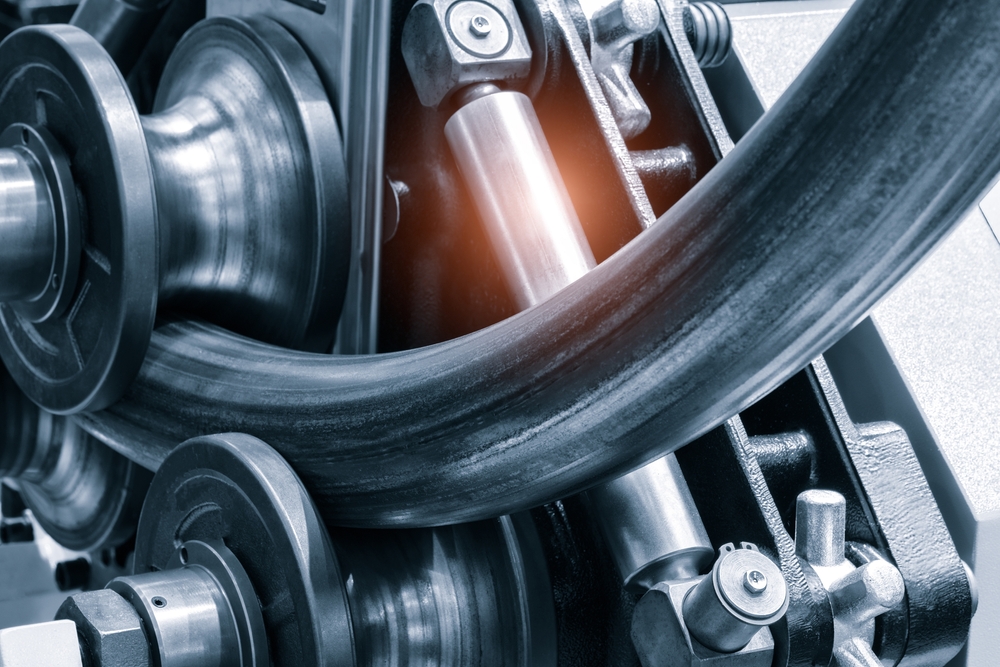
Custom pipe bends present unique fabrication challenges that standard fittings simply cannot address. Industrial pipe bending requires precise control over bend angles, bend radii, tangent lengths, and overall spool geometry. When a pipe must navigate around existing equipment, pass through a tight structural bay, or connect two fixed nozzles at irregular angles, there is no room for approximation. Even small deviations can make a spool impossible to install without forcing, which risks damaging equipment and creating stress concentrations in the piping system.
With a digital twin derived from accurate laser scan data, fabricators receive much more than a set of dimensions. They receive a complete geometric context. The virtual model shows not just where a pipe needs to go, but what obstacles it must avoid, what structural members it will run parallel to, and what the exact nozzle orientations are at both endpoints. This context allows engineers to design custom pipe bends with a level of confidence that was previously unachievable without extensive manual measurement and field verification.
CNC pipe bending machines can now be programmed directly from models derived from laser scan data, eliminating the hand-off errors that traditionally occurred when a draftsman’s drawing was interpreted by a machine operator. The path from scan to digital model to fabrication instruction becomes a single, continuous data workflow, and the risk of introducing errors at each transition point drops significantly.
Reducing Rework and Improving Project Timelines
Rework is one of the most damaging forces in industrial construction and plant maintenance. When a pipe spool arrives on site and does not fit, the costs go well beyond the price of fabricating a replacement. The project timeline stalls, scaffolding may need to remain erected, other trades are delayed, and the carrying costs of idle labor and equipment accumulate quickly. For turnaround projects where a facility is shut down specifically to allow maintenance and upgrades, every extra day offline has a measurable financial impact.
The integration of 3D laser scanning and digital twin workflows into pipe spool fabrication directly targets this problem. Studies and field reports from industrial contractors consistently show that first-time fit rates improve dramatically when fabrication is based on laser scan data rather than traditional field measurements or aging drawings. Some fabricators report near-elimination of dimensional rework on projects where full scan-to-fabrication workflows are in place.
The benefits also show up in procurement and scheduling. When the design team works from an accurate digital twin, material take-offs are more reliable, which means fewer shortfalls and fewer over-purchases. Fabrication shops can plan their production schedules with greater confidence because the dimensions they are working from are accurate and verified. The cumulative effect on project timelines and budget performance can be substantial, particularly on large-scale industrial pipe bending programs involving hundreds of spools.
Integration with Modern Fabrication Workflows
Adopting digital twin and 3D laser scanning technology does not require a complete overhaul of existing fabrication operations. The most successful implementations treat these tools as additions to an established workflow rather than replacements for it. Experienced pipe fabricators bring the domain knowledge required to interpret scan data intelligently, identify potential installation challenges, and make sound engineering judgments about custom pipe bends.
Software platforms that handle point cloud processing and pipe modeling have become increasingly accessible and user-friendly in recent years. Integration with common CAD and pipe stress analysis tools means that scan-derived models can flow smoothly into the broader engineering environment. Fabrication shops that invest in developing this capability are finding that it becomes a competitive differentiator, particularly when bidding on complex retrofit and brownfield projects where accurate as-built data is critical.
Training plays an important role in successful adoption. Personnel who understand both the capabilities and the limitations of laser scan data are better equipped to use it effectively. The technology is powerful, but it rewards users who bring sound engineering judgment to the interpretation of results.
Conclusion
Digital twins and 3D laser scanning for piping are no longer optional upgrades for forward-thinking fabricators. They are becoming the standard for any operation serious about accuracy, efficiency, and first-time fit performance in custom pipe bends and pipe spool fabrication. As the tools become more affordable and the workflows more refined, the gap between fabricators who have adopted them and those who have not will continue to grow. For industrial pipe bending operations looking to reduce rework, tighten schedules, and deliver higher-quality results, the path forward runs directly through these technologies.
Need an Industrial Machine Shop in Baton Rouge, LA?
Established in 1956, our team here at Metal Works Corporation is an A.S.M.E. certified industrial fabrication company specializing in pipe and tube bending, pipe fabrication, coiling, vessel fabrication, and welding for major industries. Our in house’ machine shop has unique capabilities and produces specialty springs of all alloys, custom rotating mechanical seals, and various other industrial components. We appreciate our customers and work to forge lasting relationships built on trust and reliability. Contact us today and allow our team to be the shortest distance between problem and solution for your unique industrial requirements.